
LAST WEEK’S KEY FACTORS AND MAIN TRENDS IN THE DEVELOPMENT OF THE SITUATION AROUND UKRAINE
(January 01–08, 2017)
I. Major-Profile Events in the Development of the Situation around Ukraine
Despite the complexity of 2016, it was characterized by a number of important events of strategic importance for our country. The most important were as follows:
 Firstly — the adoption by the UN General Assembly (19 December 2016) of the Resolution “The Situation of the Human Rights in the Autonomous Republic of the Crimea and Sevastopol (Ukraine)”. The Document for the first time at the official level, the UN calls Russia an occupier country. It complements Resolution of the Parliamentary Assembly of the Council of Europe of October 12, 2016 “Political Consequences of the Russian Aggression in Ukraine” and the Annual Report of the Preliminary Investigation, prepared by Prosecutor of the International Criminal Court in The Hague (The Hague Tribunal) Fatou Bensouda and published November 14, 2016, which recognized Russia’s armed attack (aggression) against Ukraine with using regular troops. It creates international legal basis for raising the question of bringing the leadership of the Russian Federation to the International Court of Justice and depriving Russia of voting rights in the UN Security Council;
 Secondly — the establishment of qualitatively new relations between Ukraine and the EU and NATO. In particular, it concerns the adoption by the Warsaw NATO summit (8-9 July 2016) of the Comprehensive Assistance Package for Ukraine, aimed at strengthening Ukraine’s defense sector and bringing it to the Alliance’s standards. At the same time they opened the prospects for Ukraine’s accession to the “Enhanced Opportunities Program” which in fact is an analogue of NATO “Membership Action Plan”. In turn, the European Union’s leadership recognized the success of reforms in Ukraine, which created preconditions for the EU’s fundamental political decisions on simplification of visa regime with Ukraine and increasing the volume of financial assistance to Ukraine. Besides, they settled the question of ratification by the Parliament of the Netherlands (the last of the European countries) of the Association Agreement between Ukraine and the EU;
 Thirdly — Ukraine’s actual getting rid of the energy, trade and economic dependence on Russia. By the end of 2016, Russia’s share in foreign trade of Ukraine had been reduced to 8 %, while the share of the EU — had risen to 40 %. Since the end of November 2015, Ukraine has actually stopped buying gas from Russia, and provides its own needs by the reverse supply from Europe. Thus, Russia has lost the main levers of economic and, in general, of political pressure on Ukraine. Evidence of this was the failure of Moscow’s attempts to implement the scenario of the “third Maydan” in Ukraine in autumn 2016 and to create preconditions for restoration of the pro-Russian government in our state;
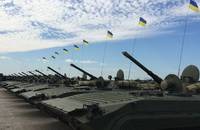 Fourthly — the strengthening of the Armed Forces of Ukraine, which allowed them to actually take the initiative in the conflict zone in the Donbas, and to block all the enemy’s attempts to capture more comfortable positions on the front line. Besides, Ukraine’s military potential already largely allows to provide resistance to Russia’s possible attempts to conduct a large-scale offensive against our country;
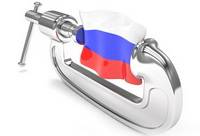 Fifthly — the emergence of critical negative trends in Russia’s economy and its financial system under the influence of Western sanctions. First of all, this concerns the exhaustion of the major financial reserves of the Russian Federation, which significantly limits the ability of the Russian government to further support the main economic sectors in the country. In turn, this makes Putin’s regime face a real threat of uncontrolled development of the socio-political and economic situation in the country, undermining the Kremlin’s ability to implement its neo-imperial plans.
At the same time, 2016 was the year of quite big disappointments for Ukraine. First of all, Russia’s continuing military aggression against Ukraine, which did not allow to achieve positive shifts in the settlement of the situation around our State, including in terms of stopping the military confrontation in the Donbas and returning the Crimea to Ukraine.
Apart from this, very bad for Ukraine was the delay in the entry into force of the EU’s decisions on simplifying visa regime with our country, as well as the removal (at the request of the Netherlands) of a number of important provisions from the Association Agreement between Ukraine and the European Union. This complicated the process of Ukraine’s European integration and to some extent reduced the level of the Ukrainian society’s confidence in Europe.
Warning signals for Ukraine were also the election of D. Trump the new US President and the growing Euroskeptic moods in Europe, which could undermine the unity of the positions of Western countries and international organizations on the issue of the continuation of the policy of pressure on Russia and supporting our State.
II. Russia’s Armed Aggression against Ukraine
Russia’s armed aggression against Ukraine remains a major threat to all countries in the area of responsibility of the Organization for Security and Cooperation in Europe. An evidence of understanding of the fact by the OSCE leadership, was the visit to Ukraine (3-4 of January 2017) of the new head of the Organization — Minister of European, Integration and Foreign Affairs of Austria Sebastian Kurz, who visited the conflict zone in the Donbas.
The aim of the visit was to show the new leadership of the OSCE the situation in the East of Ukraine, first of all — the progress in the implementation of the Minsk agreements. Besides, were studied the possibilities of the deployment of the OSCE Armed Police Mission in the Donbas and the question of increasing the efficiency of the OSCE Special Monitoring Mission in Ukraine.
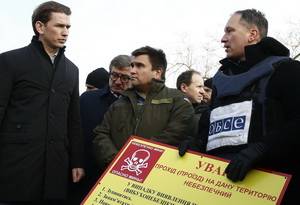 As a result of his visit, S. Kurtz acknowledged the tensions in the conflict zone, and based on that, he specified the OSCE’s main tasks in Ukraine. First of all, they will include ensuring full implementation of the agreements on ceasefire in the Donbas, as well as improving the humanitarian situation in the region. To solve the problems in the security sphere, the OSCE plans to extend the zone of its control to the entire territory of the Donbas and to increase the number of surveillance equipment on the front line. Besides, Austria, presiding over the OSCE, plans to provide humanitarian assistance to the local population in the amount of 2 million Euros.
At the same time, S. Kurtz expressed doubts about the possibility of deployment in the conflict zone in the Donbass of the OSCE Armed Police Mission in the nearest future. According to him, resolving this problem requires the consent of all members of the Organization, and allocation of significant funds for the Mission (more than 1 billion Euros), which would require quite long consultations. For this end, S. Kurtz plans to visit several OSCE countries, including the Russian Federation.
According to experts’ estimates, Austria’s rather cautious attitude to Russia’s armed aggression against Ukraine will not help speedy settlement of the situation in the Donbas. At the same time, S. Kurtz’s visit to the conflict zone, as well as his personal experience of the consequences of Russia’s military actions in Ukraine will allow the new head of the OSCE more deeply understand the policy of V. Putin’s regime and its disruptive impact on security in Europe.
2.1. The East of Ukraine (The ATO zone)
Despite the previous agreement on the establishment of a truce for a period of Christmas and New Year holidays, during the week the Russian-terrorist forces carried out active massive shelling of the ATO forces’ positions on almost all directions. Besides, these attacks were especially intensive exactly during the new head of the OSCE S. Kurtz’s visit to the east of Ukraine.
This once again confirmed Russia’s fundamental unwillingness to fulfill its obligations, and Moscow’s ignoring all international organizations, including OSCE. In fact, Russia has already convinced itself of the ability to act with impunity given the expected changes in the US and EU politics. Based on this, V. Putin’s regime demonstrates the impossibility of any change in its policy towards Ukraine, including in the issue of settlement of the situation in the Donbas.
2.2. The Crimean Peninsula
To strengthen its positions in the Crimea, the Russian Federation’s leadership continues personnel changes in key positions in the occupying government of the Peninsula. At this, the local officials are mostly replaced by immigrants from Russia. This ensures complete loyalty of the government bodies of the Crimea to Moscow and changes the social composition of the population of the Peninsula. In particular, as a result of this policy, one of the new judges of the Municipal Court in Sevastopol was appointed E. Balatsky — a former judge of the District Court of the Krasnoyarsk Territory (in 2016, eight judges of Sevastopol — locals of the Crimea — were dismissed).
Along with this, the Russian Federation continues measures to attract foreign investors to develop the economy and infrastructure of the Crimea. Thus, it negotiates with the Chinese company Elevators Distribution (official representative of the German-Chinese manufacturer SRH) on supplying escalators for “international” airport in Simferopol and lift equipment for public utility sector of the Crimea and on building in the Peninsula of a plant to make elevators and lifting mechanisms.
2.3. Other Aspects of the Russian Federation’s Actions against Ukraine and the West
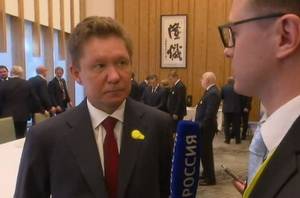 Against the background of the continuing armed aggression against Ukraine, Putin’s regime is doing its best to discredit our State in the eyes of Western countries and international organizations, and to put pressure on them over the “Ukrainian issue”. Thus, in early January 2017, the head of the Russian company “Gazprom” A. Miller once again “warned” the EU’s leaders about “the possibility of Ukraine’s unauthorized pumping of Russian gas” during the cold snap during Christmas. At this, he confirmed the Kremlin’s threat to reduce the gas supply to the European Union’s countries in case of such actions on the part of Ukraine.
At the same time, Russia organized a broad anti-Ukrainian propaganda campaign on the occasion of celebration in Ukraine of the 75th anniversary of the Ukrainian Insurgent Army and S. Bandera’s birthday. In particular, Moscow called on Germany, Poland, Great Britain, France and the United States to respond to the “Banderites’ march” in Kiev, comparing it to “supporting the Nazis”. In this context, Russia called the Anti-Terrorist Operation in the Donbas “a manifestation of the aggressive nationalism of the leadership of Ukraine”.
III. Ukraine, International Organizations and Leading Western Countries
3.1. International Organizations
The European Union. Despite some experts’ statements about the “decline of the EU’s interest to Ukraine”, our State remains in the focus of the EU’s attention. Thus, according to the EU High Representative for the Common Foreign and Security Policy, F. Mogherini, one of the priorities of her activity in 2017 will be to support the reform process in Ukraine, and to ensure successful implementation of the Association Agreement between Ukraine and the European Union. Besides, the EU will intensify its cooperation with other members of the “Eastern Partnership” program.
 NATO. In the context of Russia’s continuing armed aggression against Ukraine, the leadership of NATO and the Alliance’s leading countries are taking measures for practical implementation of the Comprehensive Assistance Package for Ukraine. In particular, on January 3, 2017, the American company Aeroc and the Ukrainian state enterprise “Ukroboronservis” signed a Memorandum on cooperation in the field of joint production of small arms up to NATO standards. Permission for such cooperation was given by the US Department of State and provides for the transfer of certain US technologies to Ukraine.
3.2. Leading Western Countries
The USA. Lately, a political scandal have been growing in the USA due to Russia’s intervention in the presidential elections in the country. Thus, on 6 January 2017, the FBI, the CIA and the US National Security Agency declassified their joint report with the evidence of such Moscow’s actions, and Russian President V. Putin’s personal involvement in them.
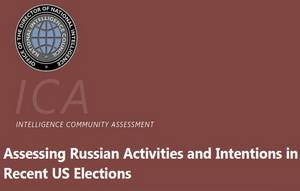 The special services’ conclusions were supported by the sitting US President and by the majority of members of the Congress. For example, B. Obama’s administration has launched an appeal to D. Trump on the inadmissibility of his ignoring the intelligence services’ data, because it directly undermines the foundations of the national security. In turn, the Congress equated Moscow’s interference in the election process in the United States to the act of aggression. Taking this into consideration, the supreme legislative body of the United States is considering a new draft law on introduction of comprehensive sanctions against Russia. The constancy of the Congress’ positions was confirmed by the new Speaker of the Lower Chamber — representative of the Republican Party P. Ryan.
Despite this, D. Trump and his associates continue denying the above-mentioned accusations against Russia, citing “no conclusive evidence” and “the possibility of other parties’ intervention in the election”. However, he did recognize the fact of Russia’s and China’ s attempts to gain access to the information resources of the US government agencies and confirmed his intention to strengthen the struggle against cyber espionage.
At the same time, D. Trump and his team have turned to direct pressure on the US intelligence services. In particular, D. Trump expressed his intention to carry out a radical reform of the US Intelligence Community (including to carry out personnel changes and reduce the number of the personnel) because of the “bias and excessive politicization of its work”.
All this is a reflection of the sharpening confrontation between D. Trump and his opponents in the US political and business circles, who are trying to get the powerful levers of influence on the country’s new President. Thus, the recognition of the external influence on the election process in the United States has questioned the legitimacy of the results of the elections, and as a result of D. Trump’s powers. (At the same time, on 6 January 2017, the two Chambers of the US Congress approved the results of the US presidential elections, won by Donald Trump; Michael Pence was approved to the post of the Vice-President of the USA).
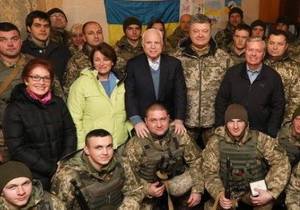 The above-mentioned situation influences the USA’s policy towards Ukraine, which in fact has become a hostage of various political and business groups in the American establishment. In particular, during US Senators J. McCain, L. Graham and E. Klobuchar’s visit to Ukraine at the end of last year, they expressed clearly the US Congress’ intentions to continue pressure on Russia and to support Ukraine. Against this background, there grows the number of statements and recommendations by all sorts of D. Trump’s advisors and candidates for positions in his administration about the need for concessions to Russia over the “Ukrainian issue”.
Despite these differences, the United States continues to fulfill its commitments to contain Russia by strengthening the US military presence in Europe. January 6, 2017, into the German port of Bremerhaven, there came first transport ships with military equipment of the 3rd Brigade (Armored Brigade Combat Team) of the 4th Infantry Division of the US Armed Forces. The Brigade’s main units will be deployed in Poland and the Baltic countries.
IV. Other Important Trends and Developments that Affect Ukraine’s National Interests
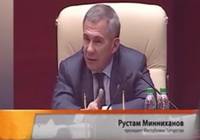 Russia. The state budget deficit is forcing the Russian government to increase the volumes of withdrawal of funds from economically successful regions of the country (in the form of higher taxes) for the sake of providing assistance to depressed subjects of the Federation. In turn, this creates preconditions for deterioration of relations between the federal government and local authorities. At this, the more apparent become the problems connected with Russia’s annexation of the Ukrainian Crimea.
In particular, last week, the head of the Republic of Tatarstan R. Minnikhanov accused the Russian Federation’s leadership of leading the unfair regional policy in terms of ensuring the survival of one region at the expense of others. In this regard, he singled out the Crimea, which becomes a burden for the Russian financial system. This caused the RF Prime Minister D. Medvedev’s sharply negative reaction. He latter pointed out the inadmissibility of the regions’ interference with the policy of the Federal Center.
This situation poses a real threat of a “rebellion” of the subjects of the Russian Federation and a spread of separatist processes in Russia, as it has already happened in the mid-1990s. This threat becomes particularly dangerous in the Muslim regions of the Federation, with the high level of anti-Russian sentiments.
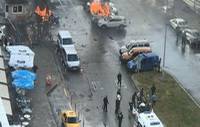 International Terrorism. Last week there was another surge of terrorist activities of Islamic extremist groups. In this regard, the loudest were the terrorist attacks in Turkey on the 1st and 5th of January 2017, which killed more than 40 people and 80 were injured). There were terrorist attacks also in Iraq, Syria and some other countries.
Based on the development of the situation in the conflict zones in the Middle East, the reason for the above-mentioned trends is the Islamic extremists’ (especially from the “Islamic State”) attempts to intensify the instability in the world in order to compensate for the substantial losses of their positions in Iraq and Syria. In particular, in this way they are trying to disperse the international antiterrorist coalition’s efforts and to intimidate its members. A special goal of the activities of Kurdish extremists is putting pressure on Turkey’s government and destabilizing the situation in the country in order to create conditions for establishing the Kurdish autonomy.
V. Major Trends in the Development of the Situation around Ukraine in the Future
5.1. Key Events and Trends that Will Be Most Important for Ukraine
In the nearest future, one of the main factors of influence on the interests of Ukraine will be political developments connected with the approaching of the new US President D. Trump’s inauguration. First of all, this will involve further intensification of Russia’s efforts to influence D. Trump’s attitude to the “Russian” and “Ukrainian” issues before his official coming to power in order to prevent the adjustment of his positions after taking the post of the head of the state.
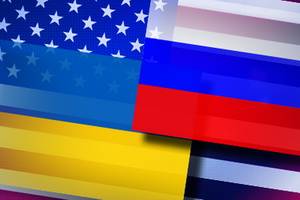 Such Moscow’s efforts would include certain work with D. Trump and his associates by diplomatic means, and through the Russian lobby in the US political and business circles. Besides, there will continue the information campaign to discredit Ukraine (by leveling the above-mentioned achievements of our country and “bulging” its problems), and by “proving” the need for changes in US policy towards Russia and Ukraine. Such a campaign will widely involve both Russian, and Western and Ukrainian politicians and experts of pro-Russian orientation. In particular, one of the first manifestations of this was the French presidential candidate Marine Le Pen’s statement on the “lawfulness” of Russia’s annexation of the Crimea, as well as one of the candidates for the post of US Ambassador to Russia Thomas Graham’s (by the way, the Adviser to ex-Secretary of State Henry Kissinger) recommendations about the possibility of resolving the situation around the Crimea by providing financial compensation to Ukraine or holding another referendum in the Crimean Peninsula.
Such actions of Russia and D. Trump and his associates’ personal interests may result in the new US administration’s attempts to reach a compromise with Russia at the expense of Ukrainian interests. In the context of this policy, D. Trump and his environment will try to influence members of the US Congress (including by offering them various kinds of preferences, launching a “war of compromising materials” and so on) in order to neutralize their negative attitude to V. Putin’s regime.
However, after a period of a possible dialogue between the USA and Russia (by the way, as in the initial stage of B. Obama’s presidency), the parties with a high degree of probability will return to the harsh confrontation. The reason for this (as in the previous case) will be the inevitable violation by the Kremlin (read — by V. Putin’s regime) of its obligations and commitments.
5.2. Prospects for the Development of Events in the Conflict Zones in Ukraine
Taking into consideration V. Putin’s regime’s interests regarding Ukraine, before D. Trump’s inauguration, Russia’s actions in the conflict zone in the Donbas will not change and will include the continuation of armed provocations of medium intensity. At this, Russia will reject all the initiatives of both Ukraine and the OSCE to reduce tensions along the demarcation line (the front line). Due to this, all the plans and intentions to settle the conflict, voiced by the new head of the OSCE S. Kurtz, will be doomed to failure.
Moreover, taking into account the expected by Russia changes in the USA’s politics, Putin’s regime is already preparing conditions for coordinated with Washington pressure on Ukraine with the aim of forcing our State to agree to Russia’s terms of “settlement” of the conflict in the Donbas. In particular, on 6 January, 2017, the Deputy Minister of Foreign Affairs of Russia G. Karasin expressed Moscow’s readiness to discuss the issue of the United States’ joining the Normandy format of the negotiations. At this, Russia considers the possibility of changes also in the positions of Germany and France after the elections in these countries in 2017, which will open the prospects for creation of a “united front” of their actions against Ukraine.
5.3. Other Important Events that Will Have an Impact on Ukraine’s Interests and Security
In the context of the change of power in the USA and spread of Euroskeptic moods in the EU, an important indicator of their future policy towards Russia and Ukraine will be the election of the head of the European Parliament on 17 January 2017, the World Economic Forum in Davos on 17-20 January 2017, and the Munich Conference on International Security on 17-20 February 2017.
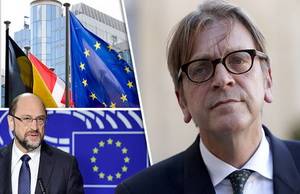 The main candidates for the post of the head of the European Parliament (EP) are: Guy Verhofstadt (former Belgian Prime Minister, leader of the EP fraction — the Alliance of Liberals and Democrats for Europe, is an active supporter of the strengthening of the EU and has a tough position regarding Russia); D. Pitella (Italian politician, leader of the EP fraction — Progressive Alliance of Socialists and Democrats, is for restoration of an inter-parliamentary dialogue with the Russian Federation), and A. Tajani (Italian politician, representative of the EP fraction — a pro-Russian European People’s Party).
According to some leading experts, Guy Verhofstadt has the greatest chance to be elected head of the European Parliament, and that would be positive for Ukraine in terms of the European Parliament ‘s continued support of our country. However, the results of the elections will depend on many factors, including on the agreements between the main political forces in the European Parliament.
In turn, the summit in Davos, and the Conference on International Security in Munich, can confirm or refute the Western countries and international organizations’ intentions to continue the policy of pressure on Russia and supporting our State. At the same time they will show Moscow’s positions and action plans for Ukraine and its Western partners.
In this context, an indicative sign of the nature of future relations between Russia and the West will be Russian President V. Putin’s decision on his participation in the summit in Davos and Conference in Munich. Previously, he refused to participate, explaining his decision by “the inadequacy of Western policy towards Russia”. That is why Putin’s agreeing to participate in these activities would mean a possibility of changes in the West’s politics.
However, in any case, the summit in Davos and the Conference in Munich may be used by Ukraine as an important international platform for letting the world community know our political positions, and for disclosing the aims and methods of the Putin regime’s actions against our country and their consequences for Ukraine, Europe and the world.
Within the framework of Ukraine’s preparation to participation in the Summit and the Conference, of great importance will be US Vice-President G. Biden’s visit to Ukraine on 15 January 2017, as it could allow to clarify the positions of the new US administration concerning our State.

